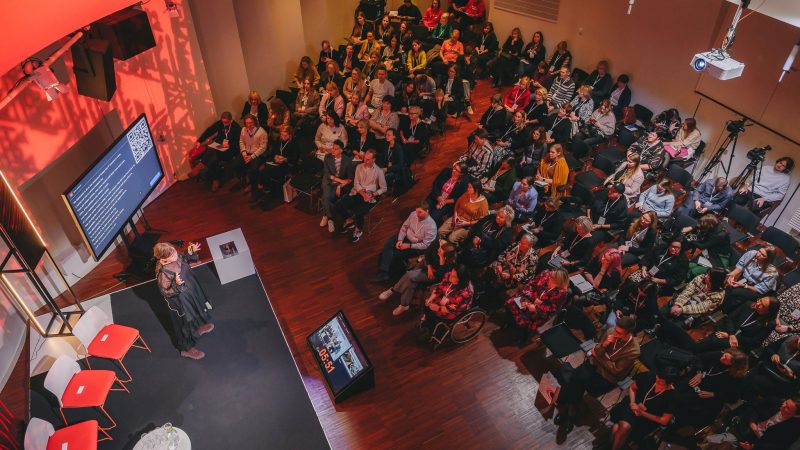
From 9 to 12 September, Liepāja will host the international European Capitals of Culture network meeting “ECoC Family Meeting 2026”. The event is jointly organised by the two upcoming European Capitals of Culture for 2027 — Liepāja and the Portuguese city of Évora — and will bring together 87 participants from 22 countries.
This annual gathering is traditionally held in a city that will become a European Capital of Culture the following year. In Liepāja, it will bring together leaders and programme-makers from former, current and future European Capitals of Culture, alongside representatives of international cultural networks and research organisations.
The working programme will focus on the long-term impact of the European Capitals of Culture initiative on urban development. Participants will exchange experience on international cooperation between cities, network development, public engagement and the role of culture in urban growth. They will also discuss how to ensure continuity beyond the title year by sustaining and developing the initiatives launched during it.
One of the discussions will focus on the experience of the Ukrainian city of Lviv in bidding for the European Capital of Culture title. Yuliia Khomchyn, Director of the Institute of Cultural Strategy in Ukraine, will speak about the bidding process, how the ideas developed during Lviv’s candidacy can be pursued despite the city not securing the title, and the significance such a title would hold for Ukraine in wartime.
“The European Capital of Culture title is not simply a year-long cultural programme — it is a long-term process that can drive change in a city, develop its cultural environment and strengthen a sense of belonging to a shared European cultural space. Hosting this international gathering in Liepāja gives us an opportunity to learn from one another, build new partnerships and jointly seek answers to the challenges facing culture and cities today,” says Inta Šoriņa, Chair of the Board of the Liepāja 2027 Foundation.
Participants will represent the United Kingdom, Belgium, Czechia, France, Estonia, Italy, Latvia, Lithuania, Montenegro, the Netherlands, Poland, Portugal, Romania, Serbia, Slovakia, Slovenia, Finland, Spain, Ukraine, Hungary, Germany and Sweden.
This year marks the 20th anniversary of the establishment of the “ECoC Family” cooperation platform. Over the past two decades, it has developed into an extensive network for exchanging knowledge and experience, connecting former, current and future European Capitals of Culture.
During the meeting, guests will explore Liepāja’s cultural venues and urban environment, including Karosta, before concluding the programme with a study visit to Kuldīga. Hosting “ECoC Family Meeting 2026” in Liepāja forms part of the preparations for 2027, when Liepāja will become a European Capital of Culture.
The European Capital of Culture is a European Commission initiative launched in 1985. Since its establishment, the title has been awarded to more than 60 cities. The initiative aims to highlight the richness and diversity of cultures in Europe, strengthen Europeans’ sense of belonging to a shared cultural space and promote the contribution of culture to the long-term development of cities.
The Liepāja – European Capital of Culture 2027 programme is delivered by the Liepāja 2027 Foundation, the City of Liepāja and official partners – the South Kurzeme and Kuldīga municipalities, with the co-founding from the Ministry of Culture.
The “Liepāja 2027” programme is supported by its main partner in environmental education and sustainability, AS “CleanR Grupa”, Jsc; its main partner in air mobility and international communications, AS “airBaltic Corporation”, Jsc; its partner in legal matters SIA “Sorainen ZAB”, Ltd; its land mobility partner, SIA “Lux Express Latvia”, Ltd; alongside its maritime mobility and international communication partner SIA “Stena Line”, Ltd; The Foundation’s media partners are: VSIA “Latvijas Sabiedriskais medijs”, Ltd; SIA “Žurnāls Santa”, Ltd; SIA “Tvnet grupa”, Ltd; and AS “Kurzemes Radio”, Jsc.