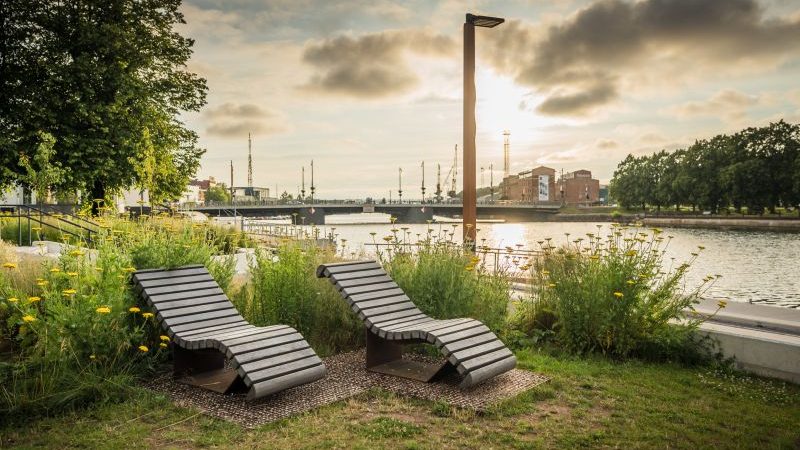
Liepāja is not only the sea and the wind. The city also has parks, squares, a promenade and courtyards where you can pause for a moment, take a walk, enjoy a coffee or tea, and see the city at a slower pace.
The three-kilometre-long Seaside Park occupies an area of 50 hectares and is currently one of the largest planted parks in Latvia. The park has walking paths, a children’s playground, cafés, several tourist attractions, football pitches, a basketball court and tennis courts.
The park also has around 170 indigenous and non-indigenous tree species, several small architectural forms and fountains. A pedestrian and bicycle path runs through the entire park.
Square of Roses is the heart of the city and its main gathering spot. As its name suggests, roses are its lasting feature and have been planted here for more than one hundred years. In spring, the first to bloom are crocuses, followed by daffodils and tulips, while in summer the roses bloom in full colour.
Historically, this was the site of the New Market. After the market was moved to Kuršu Street, an open garden with roses was created in the square. The square received its current name in 1911.
Jānis Čakste Square was originally used as a place for military training and parades, but at the beginning of the 20th century greenery was planted there. In 1925, when Liepāja celebrated its 300th anniversary, President Jānis Čakste, together with other state and city officials, planted a linden tree in each corner of the square. In honour of this event, the square was named after the first President of Latvia, Jānis Čakste.
Today, the square features an illuminated fountain, plaques with quotes by Jānis Čakste and a large Latvian flag. The square is a popular gathering place for residents, while in summer the fountain becomes especially popular with children.
During the Soviet period, Old embankment Promenade was a closed military territory, but today it is a place for peaceful walks, recreation, active city life and an artistic atmosphere.
The promenade offers views of Liepāja Concert Hall, the yacht berths of the Trade Canal, fishing boats and everyday life in the port. The promenade is also decorated by the Amber Clock, created from many pieces of amber collected by Liepāja residents.
Walking along the promenade past the Tram Bridge in the direction of the lake, you will also find a recreation area where you can quietly escape the noise of the city and enjoy a calmer side of Liepāja.
In Julianna’s Courtyard, historic industrial buildings that once housed the Keten printing house, a sandal factory and a sewing workshop have been transformed into an example of industrial architecture and loft-style spaces.
Today, the surrounding buildings are home to a restaurant, café, beer cellar, bar and various creative businesses.
Courtyard “Romas dārzs” is located in a building created in the 19th century as a shopping arcade with a spacious and romantic courtyard, typical of European capitals at the time. Later, the building was transformed into a hotel.
Today, the building houses a hotel, bakery, offices and shops, while the underground tunnels contain an art gallery with a shop, a doll art and design museum, and a conference room.
Beberliņi recreational park is located in Karosta and covers an area of 45.3 hectares. The main natural value of this place is the pine forest that has formed on the dunes and is a protected habitat.
The forest surrounds the 8.8-hectare Beberliņi waterbody, which was artificially created by extracting sand for the construction of military sites.
Plan an unhurried walk through Liepāja’s parks, squares, promenade and courtyards to discover the city in different ways, through nature, history, architecture, the closeness of water and everyday city life.